
Saturday, 31 January 2026

Tuesday, 24 December 2024
Friday, 14 June 2024
Friday, 7 April 2023
Sunday, 11 September 2022
Excommunication

Interested parties who wish to receive documentary evidence held against Illtyd Thomas should contact Bishop Seán Manchester. In the meantime, the following facts, supported by witness testimony, are communicated to clear up any ambiguity or uncertainty that may exist:
—— When Bishop Seán Manchester and others in his church who accompanied him first made contact with Illtyd Thomas in early 1990, they did so as an existing church that Bishop Seán Manchester led.
—— At no time during Bishop Seán Manchester’s period preparing for diaconation, ordination to the priesthood and episcopal consecration was he under an Oath of Canonical Obedience to Illtyd Thomas.
—— At no time did Bishop Seán Manchester sign anything resembling an Instrument of Canonical Obedience to Illtyd Thomas. He has always maintained his independence.
—— It was always understood during Bishop Seán Manchester’s preparation for Holy Orders that he did so as an extant and independent church and, therefore, remained autocephalous before, during and after the threefold ordinations that transmitted lines of apostolic succession, which was the sole object of the exercise.
—— Three bishops took part in the episcopal consecration of Bishop Manchester in October 1991, including Bishop Michael Weston of Ealing, London, and Bishop James Henry Vermeulen of Holland.
It is uncanonical for Illtyd Thomas or anyone else to lay claim to possess power to “laicise” Bishop Seán Manchester. Illtyd Thomas claimed this after falling under the influence of a convicted felon and pseudo-occultist by the name of David Farrant in early 2007. Such allegations instantly render the claimant suspect as any action of this kind would be regarded uncanonical and without meaning by other churches. David Farrant had been waging a malicious vendetta against traditional Christians in general and Bishop Seán Manchester in particular for a great many years. Farrant had criminal convictions for malicious vandalism in a cemetery, indecency in a churchyard, tomb desecration by the use of black magic, threatening witnesses in a colleague’s sex case with voodoo “death dolls” transfixed with pins (Farrant’s colleague was later found guilty of sexually assaulting a young boy), illegal possession of a firearm, and theft from a hospital. Farrant was sentenced to a term of four years and eight months imprisonment at London’s Old Bailey in June 1974. He evinced absolutely no remorse following his release and exponentially worsened with time.
A member of the Ecclesiastical Law Society brought to our attention documentary evidence that Illtyd Thomas had a criminal conviction for theft, has blessed homosexual “unions” and has wittingly “ordained” sexually active sodomites. Illtyd Thomas also cultivated a close association with the one of the most notorious paedophiles in criminal history in the UK – Roger Gleaves – who “ordained” him sub conditione (we now possess copies of the “Instruments”) despite Illtyd Thomas always having strenuously denied this allegation against him. He is also known to have had associations with various other paedophiles, many of whom are now deceased. It had been known for a long time that Illtyd Thomas had had innumerable occult connections – including Masons, Theosophists and sundry occultists – some of whom he illicitly ordained. David Farrant, possibly Britain’s most infamous self-publicist in phoney witchcraft and pseudo-occultism, befriended Illtyd Thomas in early 2007, having been an invited guest to Illtyd Thomas’ Muswell Hill home in north London. Farrant, who lived on state benefits throughout his entire life (23 January 1946 - 19 April 2019), resided less than a mile from Illtyd Thomas in an attic bed-sitting room occupied since his parole release from prison.
Since colluding with Farrant in early 2007, Illtyd Thomas had been the subject of much discussion and concern by innumerable Old Catholic jurisdictions in the UK. It had already been decided to excommunicate Illtyd Thomas upon discovery in December 2006 that he was still alive. He had been investigated thoroughly with due consideration since documentary evidence was received in 2002.
Hence, at thirteen hundred hours, ie 1.00 pm (GMT), on the Feast of St David, the former bishop of the autocephalous Old Catholic jurisdiction known as the “Celtic Catholic Church” was duly excommunicated on the grounds of violating the sacred species and his office by ordaining and consecrating sexually active homosexuals, paedophiles, occultists and criminals; being guilty of heresy by accepting sexually active homosexual, paedophile and occultic clergy, and colluding with a malefic individual who is a pseudo-occultist, ie David Farrant, to do harm to the ministry, church and person of another autocephalous jurisdiction overseen by Bishop Seán Manchester. The excommunication was officiated and led by Bishop Manchester using the traditional formula in the Roman Rite.
Bishop Seán Manchester’s statement (published March 1st 2007) on Illtyd Thomas
“It was brought to our attention toward the end of 2006 that, much to our surprise, Illtyd Thomas still remains alive. Due to his age and infirmity, we had thought him long since deceased. Illtyd Thomas evinces no website, no internet presence, no known clergy and no known ecclesial activity beyond occasionally ordaining inappropriate candidates. In the last handful of years he has ordained and consecrated active homosexuals who were also openly Theosophist with transparent occult leanings and esoteric involvement.
“We have not maintained contact since last seeing Illtyd Thomas soon after our episcopal consecration by Bishops Vermeulen, Weston and Thomas on the Feast of St Francis of Assisi 1991. The time spent with Illtyd Thomas was less than fifteen months in which period we witnessed nothing seriously untoward save on our very last visit to Illtyd Thomas’ home in Muswell Hill, London. Homo-erotic material in the form of a calendar depicting naked males was on display which Illtyd Thomas attributed to a visitor whom he was allowing to stay at his home. We consequently never visited again and severed all contact. We had approached Illtyd Thomas in spring of 1990 as an extant Church, established some seventeen years prior, with view to the transmission of lines of Apostolic Succession. This much was achieved with our diaconation in June 1990, ordination to the priesthood in July 1990, and elevation to the episcopate in October 1991. At no time during all this were we under an Instrument or Oath of Canonical Obedience to Illtyd Thomas.
“The comments about Illtyd Thomas on pages 91-92 of the book about our ecclesial history and its roots, The Grail Church (1995), were made in good faith. Illtyd Thomas was at that time given the benefit of the doubt. Then came Simmons’ overture to a member of our Church who had been with us from the beginning as a founder-member of Ordo Sancti Graal inaugurated at Easter 1973 (as recounted at the time in public annals and The Grail Church). The disturbing opening line from the pederast John Simmons in a letter, dated April 1st, 1995, to Br Keith Maclean states: ‘My good friend Bishop Illtyd Thomas has passed me your address and suggested that I should write to you.’ Simmons then went on to say that Illtyd Thomas mentioned to him that Br Keith Maclean was working towards his ordination and Simmons was ‘urgently looking for those interested in the priesthood.’
“John Simmons, quite apart from being invalid (Illtyd Thomas informed us that no evidence existed of him ever being diaconated which allowed for the Instrument of Release and Degradation issued in 1986 to be an appropriate course of action), had been subsequently anathematised and not without good reason. Simmons was a man with a history of deception resulting in imprisonment, who associated with pederasts, and who lived with a former rent boy. He extracted large sums of money from strangers, mostly individuals visiting from America, looking to be ‘ordained’ and ‘consecrated’ by Simmons (all on the same day) in his small garage. When John Simmons died there was no provision made for a religious service (he received a secular one), and his male lover was quickly evicted by his mother from the house they had occupied. Yet nine years after being released and degraded by Illtyd Thomas, this man was allegedly given a private address in order to write and offer to one of the twelve founder members of Ordo Sancti Graal an ‘ordination.’ This we found unacceptable in the extreme and impossible to reconcile with respect for our autocephalous Catholic Church.
“Let us remind ourselves of the offences that we know about which resulted in John Simmons receiving a jail term:
“Mr Simmons was given two-year concurrent sentences for nine admitted offences of obtaining property or services by deception in January 1984, when he asked for 45 similar offences to be taken into consideration.” (Kentish Express, March 20th, 1986).
“John Simmons, 44, has started an 18 months prison term for deception. Simmons pretended to be a missionary in West Africa to obtain sacred items from convents which he then sold by mail order from his Ashford home. Knightsbridge Crown Court was told it was not the first time Simmons has been in trouble. In 1984 he was jailed for two years for obtaining property or services by deception. And in 1986 Simmons left a trail of bad debts around Ashford. He has since been declared officially bankrupt. During the two-week trial Simmons denied six counts of obtaining property by deception and attempted deception. Some of the vestments and church ornaments he stole were said to be extremely valuable.” (Kentish Express, October 4th, 1990).
“Then there are the ‘ordinations’ received by Illtyd Thomas from Roger Gleaves. Though he has strenuously denied in the past that these ordinations took place, we received in 2002 evidence in the form of copies of the ‘Instruments’ themselves which clearly show that Illtyd Thomas was diaconated and priested sub-conditione by the notorious pederast and convicted felon Roger Charles Augustine Gleaves, Bishop of Medway of the Episcopal Apostolic Church on July 23rd, 1977, at the Oratory of St Michael the Archangel, Muswell Hill, London. This association with Gleaves is impossible to explain away. We only came into possession of these documents when a lawyer and member of the Ecclesiastical Law Society, now also a bishop, included them when he communicated the following:
“Thomas on this evidence is a liar, a thief, a sodomite, and a sexual pervert who has the temerity to describe his foul behaviour on his own church notepaper. He was ordained to all his Orders up to the priesthood by Roger Gleaves, probably the most infamous paedophile in British legal history.” (Correspondence received from Bishop Barry Peachey, May 29th, 2002).
“The documents all bear Illtyd Thomas’ very recognisable handwriting and signature. One in particular, for example, is written on Illtyd Thomas’ notepaper with his familiar seal imprinted by a rubber stamp. It is dated February 11th, 1986, and written to ‘John.’ It begins:
“I have sent the letter to Bishop Dominic, also I have enclosed the photograph of Mark, it is not a good one but no doubt it will give you some idea of what he looks like. He has a fine good body and a joy to see when he is naked.” (Correspodence from Illtyd Thomas to ‘John,’ February 11th, 1986).
“It continues for the remainder of the page in the most pornographic and unrepeatable fashion imaginable, eventually signing off with a postscript about the arthritis in his fingers. We have seen enough examples of Illtyd Thomas’ handwriting, syntax and style in the past to know this correspondence to be authentic. ‘Bishop Dominic’ is clearly Dominic Pyle-Bridges who was convicted of serious sex offences, and was reported by Russell Hotten in the Friern Barnet Chronicle, May 30th, 1985, to have been ‘consecrated’ by ‘Illtyd Thomas, an archbishop in the Celtic Catholic Church’ in a service at the Muswell Hill Centre, Hillfield Park. In the previous year, Pyle-Bridges appeared in a London court under the name Stanley Bridges and was fined £80 for committing gross indecency with two male teachers in a Soho theatre. Why would Illtyd Thomas want to even consider ordaining sex perverts such as Pyle-Bridges and Simmons while receiving superfluous ordinations himself sub-conditione from one of the most vile pederasts to have ever drawn breath?
“A point that often puzzles non-Catholics is that once valid Holy Orders have been bestowed, according to normative Roman Catholic canon law, there is no power on earth that can remove them. This applies even if the priest or bishop has been criminally convicted, regardless of his state of sin, and also in the event that he is heretical or simonistic. The Donatist heresy established many centuries ago that the validity of a sacrament is in no way dependent on the character or actions of the clergyman concerned. Illtyd Thomas, therefore, would remain until his death in valid Holy Orders. His lines of Apostolic Succession derived from such as +W A Barrington Evans, +A W J Williams and +Bertil Persson, and those who inherit them such as our Church, are obviously unaffected.
“The right to excommunicate, however, is an immediate and necessary consequence of the fact that the Church is a society. Every society has the right to exclude and deprive of their rights and social advantages its unworthy or grievously culpable members, either temporarily or permanently. This right is necessary to every society in order that it may be well administered and survive. The fundamental proof, therefore, of the Church’s right to excommunicate is based on her status as a spiritual society, whose members, governed by legitimate authority, seek one and the same end through suitable means. Members who, by their obstinate disobedience, reject the means of attaining this common end deserve to be removed from such a society. Notice was, therefore, served early in 2007 by Ecclesia Vetusta Catholica (a traditional Old Catholic Church in Great Britain), that Illtyd Thomas, former Bishop of an autocephalous jurisdiction known as the ‘Celtic Catholic Church’ would be excommunicated on March 1st, 2007.”
Response to Ecclesia Vetusta Catholica from David Sattman
“When I had first heard that Bishop Illtyd Thomas had been formally excommunicated with bell, book, and candle, a most solemn and ancient rite rarely used in modern times, I thought Bishop Manchester had overreacted or perhaps even overstepped his bounds. I especially thought so in light of Bishop Thomas’ advanced old age and the likelihood that some amount of dementia has set in.
“But then upon further reflection I considered how long Bishop Thomas has been associating with the avowed enemies of Bishop Manchester and the level of vitriol these people have heaped on Bishop Manchester for all these decades. Furthermore Bishop Thomas has chosen to befriend this notorious band of cut-throats and be taken into the bosom of hell by his own free will. No one forced him to do it, it was his own decision. I believe that he understands what it was he was doing and that the consequences of association with these vile necromancers and diabolists would lead to his excommunication.
“Perhaps some people may think that Bishop Manchester was rather melodramatic using the ancient rite as he did, but the gravity of falling out of the grace of the Church of God must be pointed out in no uncertain terms and that the solemn gravity of excommunication via bell, book, and candle was necessary to drive home this point.
“I pray for the possibility that Bishop Thomas may still, even at this late stage of the game, recant his association with the sworn enemies of Bishop Manchester, repent of his sins, and perhaps still enjoy a return to Christ. It seems however, that his hard heartedness will not allow this. Too bad!
“I wish the Roman Pontiff would excommunicate a few bishops within the fold of the Latin Rite. But then there is the danger of one of these people claiming ‘martyrdom’ as a sort of ‘sacrificial lamb’ on behalf of the liberals and the onset of schism.”
Response to Bishop Seán Manchester from Brother Keith Maclean OSG
“It is difficult to say anything with regard to Illtyd Thomas — you have said it all. Simmons and Thomas seem to have been birds of a feather, along with Gleaves. The early connection with Gleaves is indicative of the worst. All I can say is that you have handled the matter perfectly. That malefic and vicious opposition which you face from such people is a seal of approval on your ministry.”
Response to Ecclesia Vetusta Catholica from an Old Catholic Bishop
“We agree that the action which Illtyd Thomas threatened would be both uncanonical and unwise. He is, however, clearly very frightened of David Farrant and his judgement is impeded by this.”
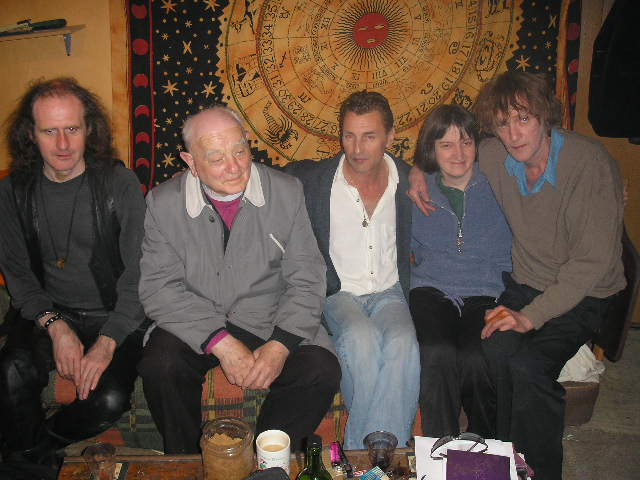
Illtyd Thomas seated between diabolists Gareth Medway (far left) and David Farrant (far right).
Wednesday, 17 February 2021

Friday, 29 January 2021
Validity

Validity – Are we validly Catholic?
If the Roman Catholic Church is your source of truth in these matters, see what the Roman Catholic Church teaches in it’s official document “DOMINUS IESUS,” issued during the reign of Pope John Paul II, June 16, 2000, and signed by Joseph Cardinal Ratzinger, now Pope-Emertus Benedict, August 6, 2000, refer to Section IV: Article 17:
"Therefore, there exists a single Church of Christ, which subsists in the [Roman] Catholic Church, governed by the Successor of Peter and by the Bishops in communion with him. The Churches which, while not existing in perfect communion with the [Roman] Catholic Church, remain united to her by means of the closest bonds, that is, by apostolic succession and a valid Eucharist, are true particular Churches."
Catholic Almanac
"The Roman Church recognises the validity of Old Catholic Orders and other Sacraments."
- Felician A Roy, OFM, 1974; p. 368.
"Therefore, the Church of Christ is present and operative also in these Churches, even though they lack full communion with the [Roman] Catholic Church, since they do not accept the [Roman] Catholic doctrine of the Primacy, which, according to the will of God, the Bishop of Rome objectively has and exercises over the entire Church."
It should be noted that our Bishops and all of our clergy have valid Apostolic Succession and this is what determines valid ordination.
What is “Old Catholicism”?
We know from history that the Church founded by Our Lord Jesus Christ was united for a thousand years. Today, however, the Catholic Church is comprised of five felow congregations:
· Roman Catholic
· Old Catholic
· Anglican Catholic / Episcopalian
· Eastern Catholic (or Eastern Orthodox)
· Oriental (Coptic, Syrian, Nestorian)
These fellow churches, together relating to each other in love, hold that through baptism, celebrated in our churches according to the faith handed down to us from the Apostles, we are each made members of the one Mystical Body of Christ.

Wednesday, 6 January 2021

Thursday, 24 December 2020


Sunday, 20 December 2020
Sunday, 6 December 2020
Sunday, 29 November 2020
Wednesday, 1 July 2020
Most Precious Blood

The Church dedicates the whole month of July to devotion of the Most Precious Blood of Our Lord. In the old calendar July 1st was its special feast day, and still remains so for Traditionalist Christians.
The Liturgy, that admirable summary of the history of the Church, reminds us every year that at this date in 1849, thanks to the French army, the revolution which had driven the Pope from Rome was vanquished. To perpetuate the memory of this triumph and to show that it was due to the Saviour’s merits, Pius IX, at the time a refugee at Gaeta, instituted the Feast of the Precious Blood. Pius XI in 1934 raised it to the First Class.
The Heart of Jesus has made this adorable Blood circulate in His limbs; wherefore, as on the feast of the Sacred Heart, the Gospel presents to our view the thrust of the lance which pierced the side of the Divine Crucified, blood and water gushing forth. Thus become united the two testimonies which the Holy Ghost bore to the Messias, when He was baptised in the water of the Jordan and when He was baptised in blood on the cross (Gradual). The Docetes taught that Jesus was the Christ at His baptism, and had thus come by water, but being no longer Christ on the cross He had not come by blood.
Let us do homage to the Precious Blood of our Redeemer which the priest offers to God on the altar.

Sunday, 12 April 2020
Easter Sunday


Christ is risen from the dead
Trampling over death by death
Come awake, come awake
Come and rise up from the grave
Christ is risen from the dead
We are one with Him again
Come awake, come awake
Come and rise up from the grave
O death, where is your sting?
O hell, where is your victory?
O church, come stand in the light
The glory of God has defeated the night
Sing it, o death, where is your sting?
O hell, where is your victory?
O church, come stand in the light
Our God is not dead, He's alive, He's alive
Christ is risen from the dead
Trampling over death by death
Come awake, come awake
Come and rise up from the grave
Christ is risen from the dead
We are one with Him again
Come awake, come awake
Come and rise up from the grave


Saturday, 11 April 2020
Holy Saturday

The fire is struck from a stone to indicate, that Christ is the light of the world, and the Stone which the Jews rejected has now become the Cornerstone of His Church (Psalms 117: 22), that the divine Son, the Light of the World, was apparently extinguished at His death, but at His resurrection shone anew; that all those who witness this ceremony today be spiritually enlightened hereafter.
This fire is blessed, because the Church blesses everything that is used for divine service, and because the light and fire represent Christ, who brought the fire of love upon earth with which to rekindle our hearts. (Luke 12: 49)
The Easter (or Paschal) candle is an emblem of Christ who has risen from death. Christ the true Light leads us from the bondage of Satan into the freedom of the children of God, as the pillar of fire led the children of Israel out of the bondage of Egypt.


Friday, 10 April 2020
Good Friday

Good Friday (also called "Great Friday" or "Holy Friday") is the most sombre day of the entire year. A silence pervades, socialising is kept to a minimum, things are done quietly; it is a day of mourning; it is a funeral. The Temple of the Body of Christ is destroyed, capping the the penitential seasons begun on Septuagesima Sunday and becoming more intense throughout Lent. Traditional Catholics wear black, cover their mirrors, extinguish candles and any lamps burning before icons, keep amusements and distractions down, and go about the day in great solemnity.
Jesus was put on the Cross at the very end of the third hour (the time between nine and noon), likely on 3 April AD 33. He died at 3pm, and then, visible from Jerusalem on that date, came a partial lunar eclipse which began at moonrise, at 3:40pm:
Mark 15: 25, 33
And it was the third hour, and they crucified Him ... And when the sixth hour was come, there was darkness over the whole earth until the ninth hour.
Because Jesus suffered on the Cross between the hours of Noon and 3:00pm, these three hours today are considered the most sacred of all. A devotion called "Tre Ore" or "Three Hours' Agony" might be held at this time; if not, you can do it yourself by meditating on His Passion, reading the Gospel narratives of the Passion, making the Stations of the Cross by yourself, praying the Sorrowful Mysteries of the Rosary, praying the Litany of the Passion etc.
No true Mass is offered today (or tomorrow until the Vigil tomorrow evening); instead a liturgy called the "Mass of the Presanctified" is offered, which is not a true Mass because no consecration takes place. Instead, we consume Hosts consecrated at yesterday's Mass. Vestment colors will be black, and the liturgy consists of lessons, prayer, St. John's version of the Passion, and ends with a long series of prayers for various intentions: the Church, the Bishops, the faithful, those engaged in public affairs, catechumens, the needs of the faithful, unity, the conversion of the Jews, the conversion of infidels. These intentions are called the Great Intercessions, and we kneel after each.
Then the Cross will be unveiled and and elevated to be adored by our kneeling three times before it at the words "Venite, adorémus" (come, let us adore). We kneel thrice because He was mocked thrice: in the high priest's courtyard, in Pilate's house, and on Mount Calvary. Then the priest lays the Cross on a cushion and covers it with a white veil to symbolise the Entombment. He takes off his shoes, like Moses before God, and kneels three times as the choir chants. He and his acolytes kneel and kiss the Cross.
The Cross is held up for us, and we file past - men first, then women - to kneel and kiss the Cross while the choir sings the Improperia (the Reproaches) of Christ, in which Our Lord reminds of us all He has done for us and our ingratitude towards Him. Note the use of the singular "thee" in these Reproaches. Our Lord is speaking to you. The first three of the twelve Reproaches are:
O My people, what have I done to thee? Or wherein have I afflicted thee? Answer Me. Because I led thee out of the land of Egypt, thou hast prepared a Cross for thy Saviour.
Because I led thee out through the desert forty years: and fed thee with manna, and brought thee into a land exceeding good, thou has prepared a Cross for thy Saviour.
What more ought I to have done for thee, that I have not done? I planted thee, indeed, My most beautiful vineyard: and thou has become exceeding bitter to Me: for in My thirst thou gavest Me vinegar to drink, and with a lance thou hast pierced the side of thy Saviour.
A second choir responds to each of those Reproaches with a trisagion in Greek and Latin. You might recognise its English translation if you have ever prayed the Divine Mercy chaplet:
O holy God!
O holy God!
O holy strong One!
O holy strong One!
O holy immortal One, have mercy on us.
O holy immortal One, have mercy on us!
The remaining nine Reproaches are answered with the response "O my people, what have I done to thee? or wherein have I afflicted thee? Answer me." ("Popule meus, quid feci tibi? aut in quo constristavi te? responde mihi."). The words evoke awe in reminding us of our ancient Israelite heritage - and evoke humility in recalling how our ancestors failed repeatedly:
For thy sake I scourged Egypt with its first-born: and thou didst deliver Me up to be scourged.
I led thee out of Egypt having drowned Pharaoh in the Red Sea: and thou to the chief priests didst deliver Me.
I opened the sea before thee: and thou with a spear didst open My side.
I went before thee in a pillar of cloud: and thou didst lead Me to the judgment hall of Pilate.
I fed thee with manna in the desert; and thou didst beat Me with blows and scourges.
I gave thee the water of salvation from the rock to drink: and thou didst give Me gall and vinegar.
For thy sake I struck the kings of the Canaanites: and thou didst strike My head with a reed.
I gave thee a royal sceptre: and thou didst give My head a crown of thorns.
I exalted thee with great strength: and thou didst hang Me on the gibbet of the Cross.
After the Reproaches, we receive Communion, receiving Hosts consecrated at yesterday's Mass.
It is customary for churches to offer the Way of the Cross devotion on this day, especially around 3:00pm, the hour of His death. And, again, there may be a tenebrae service (consisting of the Matins and Lauds for Holy Saturday). "Tenebrae" means "shadows," and they should remind us of how the skies darkened when Christ was on His Cross.


Thursday, 9 April 2020
Holy Thursday

The last three days of Holy Week are referred to as the Easter or Sacred Triduum (Triduum Sacrum), the three-part drama of Christ's redemption: Holy Thursday, Good Friday and Holy Saturday.
Holy Thursday is also known as "Maundy Thursday." The word maundy comes from the Latin word mandatum (commandment) which is the first word of the Gospel acclamation:
Mandátum novum do vobis dicit Dóminus, ut diligátis ínvicem, sicut diléxi vos. "I give you a new commandment: Love one another as I have loved you." (John 13: 34)
These are the words spoken by our Lord to His apostles at the Last Supper, after He completed the washing of the feet.

“I tell you the truth, one of you will betray Me.” They were very sad and began to say to Him one after the other, “Surely not I, Lord?” Jesus replied, “The one who has dipped his hand into the bowl with Me will betray Me. The Son of Man will go just as it is written about him. But woe to that man who betrays the Son of Man! It would be better for him if he had not been born.” Then Judas, the one who would betray Him, said, “Surely not I, Master?” Jesus answered, “Yes, it is you.”
While they were eating, Jesus took bread, gave thanks and broke it, and gave it to His disciples, saying, “Take and eat; this is My body.” Then He took the cup, gave thanks and offered it to them, saying, “Drink from it, all of you. This is My blood of the covenant, which is poured out for many for the forgiveness of sins. I tell you, I will not drink of this fruit of the vine from now on until that day when I drink it anew with you in My Father’s kingdom.”
Then one of the Twelve — the one called Judas Iscariot — went to the chief priests and asked, “What are you willing to give me if I deliver Him over to you?” So they counted out for him thirty pieces of silver. From then on Judas watched for an opportunity to hand Him over.
Then Jesus went with His disciples to a place called Gethsemane, and He said to them, “Sit here while I go over there and pray.” He took Peter and the two sons of Zebedee along with Him, and He began to be sorrowful and troubled. Then He said to them, “My soul is overwhelmed with sorrow to the point of death. Stay here and keep watch with Me.”
Going a little farther, He fell with His face to the ground and prayed, “My Father, if it is possible, may this cup be taken from Me. Yet not as I will, but as you will.”
Then he returned to His disciples and found them sleeping. He asked Peter, “Watch and pray so that you will not fall into temptation. The spirit is willing, but the flesh is weak.”
He went away a second time and prayed, “My Father, if it is not possible for this cup to be taken away unless I drink it, may your will be done.”
When He came back, He again found them sleeping, because their eyes were heavy. So He left them and went away once more and prayed the third time, saying the same thing.
Then He returned to the disciples and said to them, “Are you still sleeping and resting? Look, the hour has come, and the Son of Man is delivered into the hands of sinners. Rise! Let us go! Here comes My betrayer!”

Subscribe to:
Posts (Atom)

-
 The Church dedicates the whole month of July to devotion of the Most Precious Blood of Our Lord. In the old calendar July 1st was its ...

